(A TPWC No-BS Guide to Keeping Your Outdoor Living Space Beautiful)
When you hire The Pressure Wash Company to restore your pavers, one of the first things we talk about with homeowners is paver maintenance. Proper paver maintenance keeps your patio, walkway, or driveway looking beautiful for years and prevents costly repairs later.
Homeowners tell us all the time:
“I can’t believe I let it go this long.”
“I forgot how beautiful this was when it was built.”
“There’s no way I’m waiting another 10–15 years to fix this again.”
And honestly?
We agree.
Because your patio isn’t just a slab of stone — it’s your outdoor living room. It has no roof, no protection, and it sits in the beautiful yet unforgiving four-season chaos we call Pennsylvania.
But here’s the good news:
Maintaining your pavers between major repairs is not hard.
You just need to know what to look for — and what to do about it.
🫧let’s start with the basics to answer the $1,000,000 question 👇
What Is Paver Maintenance?
Paver maintenance includes cleaning, replacing joint sand, preventing weed growth, managing drainage, and protecting the surface with professional sealing. Proper paver maintenance keeps patios stable, safe, and visually appealing for years.
For even more information click this link to read about the 6 phases of paver restoration from our very own website – Get Expert Paver Restoration from The Pressure Wash Company
This blog is your complete, real-world guide.
🔶 Why Regular Paver Maintenance Actually Matters
You invested a lot into your patio. And Pennsylvania’s climate is constantly trying to destroy it.
✔ Freeze–thaw cycles
Here’s what happens every winter:
- Rainwater seeps between or under the pavers
- It freezes
- Frozen water expands
- The pavers heave upward
- When they thaw, they drop back down
- Your joint sand falls through the cracks
- Dirt, debris, and weeds take over the now-open joints
This is how a perfect patio becomes a trip hazard.
If you ever notice your pavers bulging up in winter, write it down — small heaves are your warning light.
🔶 UV Sun Damage
If you don’t have umbrellas, shade, a pergola, or furniture that protects the surface, your pavers are baking in direct sunlight all day.
UV rays bleach the pigmentation out of pavers.
Often the color layer is only “skin-deep” — once it’s gone, the stone starts looking like exposed aggregate.
Some people like that rustic antique look.
Others want the “like-new” finish.
If that’s you, sealing your pavers is your best defense against UV fading.
🔶 Drainage Problems: The Silent Killer
Black mildew, algae, and moss don’t magically appear.
They show up because water’s not going anywhere.
If you have:
- low spots
- flat spots
- sunken areas
- downspouts dumping directly on pavers
- shading from trees or bushes
…then you WILL get organic growth.
Moss and mildew make your pavers slippery, ugly, and unsafe — especially in shaded areas.
🔶 Ant Colonies (Nature’s Little Engineers)
Let me say this plainly:
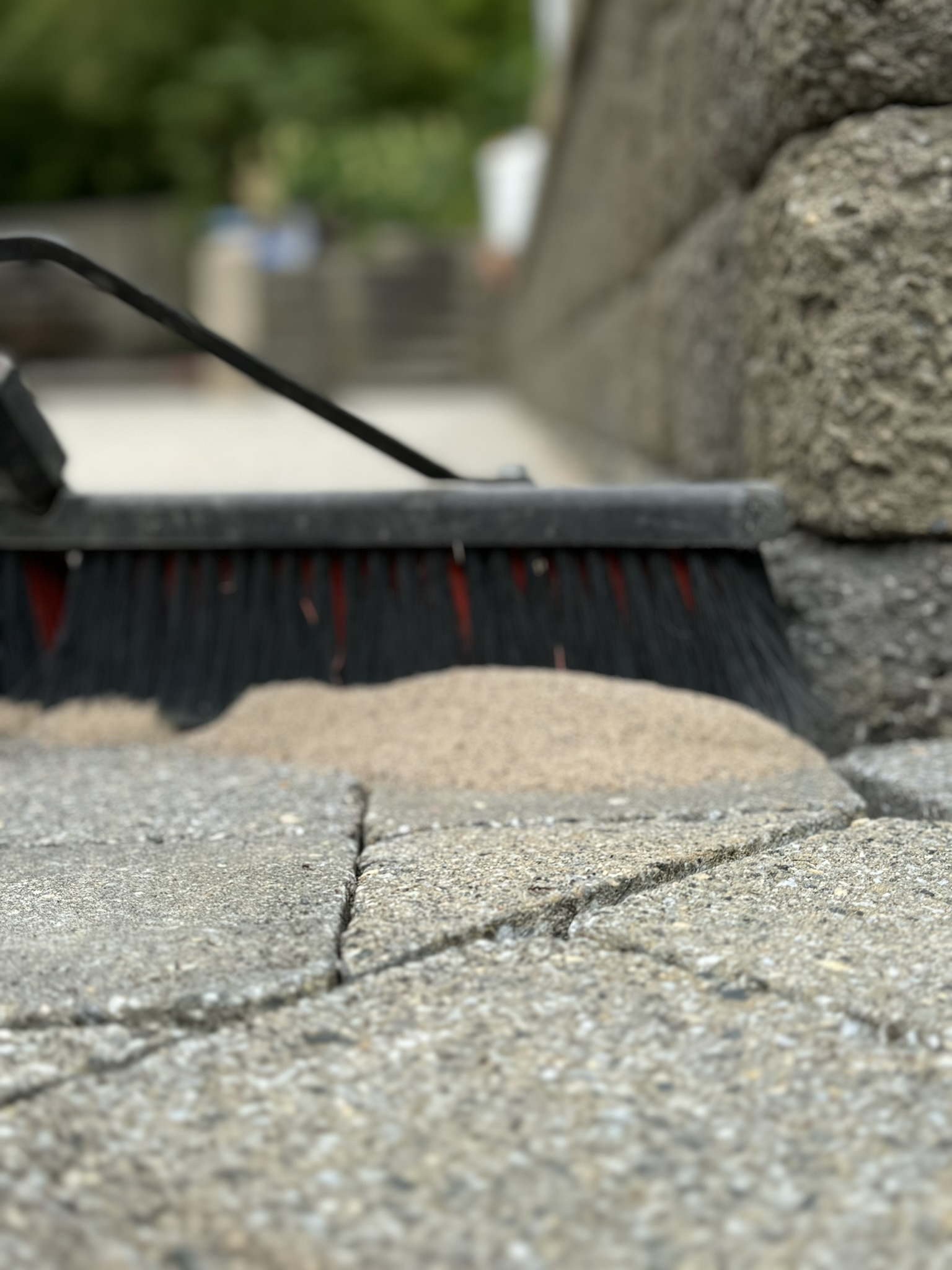
Those sand mounds you see on your patio?
That’s NOT sand.
Those are ants bringing up your bedding layer — the foundation material under your pavers — and depositing it on the surface to expand their colony.
That means:
- the base is weakening
- the pavers will start sinking
- water pockets form
- weeds move in
- the entire system becomes unstable
Ants aren’t a nuisance.
They are the beginning of a structural failure.
If you see mounds, you need intervention — period.
⭐ The Top Paver Maintenance Habits Homeowners Should Practice
Here’s the part that surprises people:
Most of the maintenance doesn’t take more than 10 minutes here and there.
✔ 1. Blow Away Grass Clippings After Mowing
Grass clippings fall into joints → roots grow → weeds take over.
This is the #1 homeowner-caused issue we see.
Ask your landscaper to blow everything off.
If they don’t, grab your own blower and do it.
Two minutes now saves you hundreds later.
✔ 2. Pull Weeds Early (And Properly)
Don’t let three weeds become thirty.
If the roots aren’t fully removed, they’ll spread beneath the pavers and pop up somewhere else.
The simple trick:
- Spray the weed once with Roundup
- Wait for it to turn brown
- Pull it using needle-nose pliers
- Dispose properly
Protective gloves recommended.
This is the easiest maintenance step in the world — until people ignore it for six months.
✔ 3. Inspect Your Sand Levels
Missing poly sand = open joints = water pooling + weed growth.
If you see gaps or holes in the joints, that’s a sign the sand has washed out.
Call us.
Replacing sand early is 10× cheaper and easier than waiting until the patio destabilizes.
✔ 4. Manage Leaves in the Fall
Leaves release tannins that stain pavers dark brown.
A quick leaf-blower session as the coffee brews in the morning prevents all of it.
✔ 5. Keep Landscaping In Check
Two HUGE issues we see constantly:
- A) Overgrown bushes blocking airflow
No sun + constant moisture = mildew farm.
- B) Surface-rooting shrubs and trees planted too close
These roots WILL lift your patio.
We’ve seen patios completely destroyed by landscaping choices.
Landscapers plant what “looks nice.”
They don’t think about root structures.
You have to.
✔ 6. Don’t Let Mulch Beds Rise Above the Patio
This one drives every contractor insane.
Every spring, people throw new mulch on top of old mulch without removing anything.
Over a few years, you end up with:
- mulch beds 12–18 inches higher than the patio
- water running from mulch onto the pavers
- black mulch dye staining everything
- nowhere for cleaning water to drain
- thousands of gallons of rinse water with no exit path
It turns routine maintenance into a nightmare.
Please.
Level your mulch beds.
✔ 7. Use Proper Cleaning Techniques
Here’s the truth:
🤦🏼♂️Most homeowners should NOT pressure wash their own pavers.
Reasons:
- cheap electric box-store pressure washers are useless
- strong gas pressure washers destroy joint sand
- wrong tips = etching lines everywhere
- bad technique = permanent zebra stripes
This is why we offer yearly or bi-yearly preventative cleaning:
✔ proprietary cleaning solution
✔ soft brushing
✔ controlled rinsing
✔ inspection included
✔ optional paver furniture rinse
On larger restorations, we often give homeowners a gallon of our mix so they can maintain the patio themselves.
🌦 Winter Maintenance Tip: Watch for Birdbaths
If you see water pooling:
- blow it off
- take note of where it forms
- mention it during your next assessment
Birdbaths become heaves → heaves become dips → dips become weeds → weeds become joint failure.
Simple observations save huge headaches.
🔥 Efflorescence: Don’t Panic
Seeing white powdery deposits?
That’s efflorescence:
salts + minerals naturally leaching out of concrete materials.
It’s not dangerous.
It’s not permanent.
It’s not a defect.
We can clean it easily — just tell us about it.
⚠️ Now Let’s Talk About Neglect — The Hard Truth
We hate telling homeowners this, but it must be said:
There is a point where your patio becomes beyond restoration.
If you let:
- weeds
- moss
- roots
- ant colonies
- missing sand
- drainage issues
- mulch overflow
- 10–20 years of no maintenance
…go completely unchecked?
Eventually the ONLY solution will be:
❌ pull up the entire patio
❌ palletize the stones
❌ remove all embedded roots
❌ rebuild the base layer
❌ reinstall everything
And that is not a restoration.
That is a rebuild.
We never want to hand someone a card for a mason or hardscaper and say:
“We’re sorry — but your patio is so overtaken by nature that we can’t restore it with any guarantee.”
But it happens.
And it’s preventable.
💬 A Personal Note From The Pressure Wash Company
We’ll never sugarcoat things:
If you care about your investments — your cars, your home, your yard, your patio — then you have to maintain them.
People wash their $85,000 car weekly.
But the $85,000 outdoor living space?
They ignore it for a decade.
It makes no sense.
Your patio deserves love too.
Maintenance doesn’t need to be complicated.
It just needs to happen.
And if you want help, we’re here — with no judgment.
⁉️Frequently Asked Questions About Paver Maintenance
How often should pavers be cleaned?
Most patios should be professionally cleaned every 1–2 years depending on tree cover, moisture, and usage.
How often should pavers be sealed?
In Pennsylvania’s climate, most pavers should be sealed every 3–5 years to protect against UV fading, water intrusion, and joint erosion.
Can I pressure wash my own pavers?
It is possible, but most homeowners accidentally remove joint sand or damage the surface. Professional cleaning methods protect both the pavers and the structural base.
What happens if I don’t maintain my pavers?
Without regular maintenance, patios can develop weed growth, sinking pavers, joint failure, moss buildup, and structural damage, eventually requiring full reconstruction.
_______________________________________________________________________________________________
⭐ Want Us to Handle Your Annual Maintenance?
We offer:
- yearly or bi-yearly paver soft washing
- inspections
- minor touch-ups
- early problem detection
- optional sealing
- furniture rinses
- scheduling reminders
You choose the timeline — we handle the rest.
📞 The Pressure Wash Company
Proudly serving Allentown, Bethlehem, Easton, Center Valley, Upper Macungie, and the entire Lehigh Valley.
👉 Call or Text: 484-424-5200
👉 Website: thepressurewashcompany.com
👉 125+ Five-Star Google Reviews
👉🏼PAHIC#203240 | Fully Licensed & Insured
Let’s protect your outdoor living space — one simple step at a time.
🫧👉🏼For even more information click this link to read about the 6 phases of paver restoration from our very own website – Get Expert Paver Restoration from The Pressure Wash Company
